
Before my forthcoming book Conjuring the Hurricane existed in any meaningful format, my dear childhood friend (and multi-Emmy award winning writer, she’d want me to add that) Liz Hara read a few early pages and said,
“I don’t even like poetry. And I want to write the introduction.”
She ended up starting it like this:
Prepare to have your guts ripped out.
To laugh until you cry.
To have your heart broken, then stitched back together stronger than it’s ever been.This book is that good.
She still doesn’t like poetry.
I hear some version of that all the time.
“I don’t read poetry.”
“I’m not a poetry person.”
“I wouldn’t even know how to understand it.”
I get it. I never went to poem school either, and this book isn’t asking you to be a poetry person. It’s just asking you to be a person.
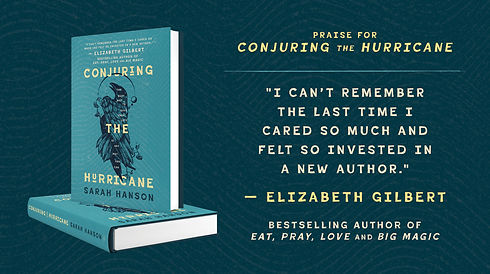
Another friend named Liz, this one of Eat, Pray, Love fame, is also a fan of Conjuring the Hurricane.
When I first tried to write the story of my escape from domestic abuse, I did what I thought I was supposed to do. I opened a blank document and tried to begin at the beginning.
I wrote a sentence about the night he threw a plate of pancakes against the kitchen wall, and almost immediately, I got stuck. Was it winter? Was it before I moved into the townhouse, or after? Was I remembering the right fight, or three fights collapsed into one?
Within minutes, I wasn’t writing anymore. I was interrogating my own memory.
That happened every time.
I could see things clearly. The yellow truck. His fist hitting the dashboard. The cigarette in his hand. The pancakes on the wall. The gun on the pillow.
The images were intact. The timeline was not. And the harder I tried to force it into a clean, linear story, the further away it moved.
Trauma doesn’t organize itself into chapters. It fragments. It overlaps. It loops. So when I tried to write this like a traditional memoir, it wasn’t just difficult. It was destabilizing.
Everything changed when I stopped trying to write it “correctly.” I joined a poetry community where no one expected full chapters. No one asked for perfect chronology. And for the first time, I wrote a single moment instead of the whole story.
Just the truck. Just the pancakes. Just the feeling in my body. If I didn’t know the exact date, I didn’t force it. If I couldn’t remember every detail, I didn’t invent it. I wrote what remained.
Here’s what that looks like on the page (from page 69 of the book):
He Threw That Plate Like a Frisbee
The first time we met for breakfast, he marked
the calendar: eight days to make me fall in love with him.A leap year later, his disappointment: bacon grease;
a ghostly presence at my breakfast table.I no longer make pancakes
for him to hurl at the wall.No more sticky smiles.
He said he wished he never met me.
That’s the whole idea. Not hidden. Not abstract. Not something you have to study. Just a moment, told as clearly as I can tell it.
The words are regular words. The meaning is not hidden. If you’ve ever lived through something hard, you already know how to read it.
The braided structure that weaves these pieces through time is intentional. A fully linear version of this story would have been overwhelming. It would have asked you to move through trauma without pause.
Instead, this form gives you space. White space to breathe. Short pieces you can step in and out of. Moments that stand on their own, but build something larger over time.
You don’t have to read it quickly. But I do hope you read it in order, and trust that it carries you somewhere. Because it does. There is resolution here. There is joy ahead.
For years, I doubted my own memory. Writing these pieces was the first time I said, without apology: This is how I remember it. This is what it felt like. This is the shape it takes in my body.
So if you’ve ever thought, “I don’t think I like poetry,” you’re exactly who I wrote this for.
Conjuring the Hurricane releases April 28. If you’ve been waiting for a way in, this is it. You can pre-order now from your favorite bookseller, and be sure to claim your pre-order bonus on my website (you just need a screenshot of the receipt, and voila).